Posts

Showing posts with the label VHDL
Image
Random Access Memory, commonly known as RAM, is a crucial component in modern digital systems. It allows for the temporary storage and retrieval of data in electronic devices. Designing RAM in VHDL (VHSIC Hardware Description Language) is a crucial skill for any digital design engineer, and in this article, we will discuss how to design RAM in VHDL using ModelSim, a popular simulation tool. If you are beginner in VLSI and VHDL, you should go with this article: Getting Started with VLSI and VHDL using ModelSim – A Beginners Guide Before we dive into designing RAM, let us first understand what it is and how it works. RAM is a type of memory that allows for data to be stored and retrieved in any order, hence the term 'random access.' RAM is made up of a series of storage locations, each of which can store a single bit of data. These storage locations are organized into words, with each word containing a fixed number of bits. The size of the RAM is determined by the number of words...
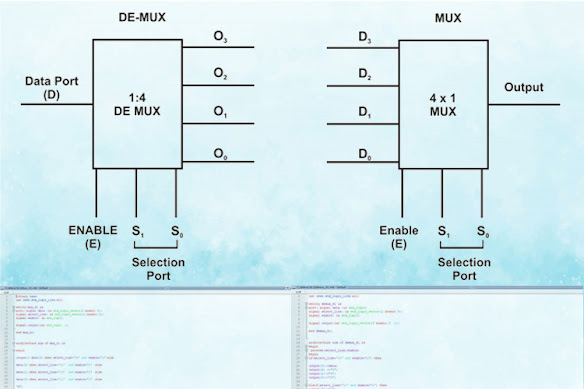
Design Multiplexer and Demultiplexer ICs using VHDL on Modelsim

Image
In the world of digital electronics, an integrated circuit called the “Multiplexer” is a device often used for the selection process. Let's dig deeper into what Multiplexer is, its specifications, and how we can design one using VHDL in Modelsim. If you are new to VHDL, check out Getting Started with VLSI and VHDL using ModelSim – A Beginners Guide . What is Multiplexer? A multiplexer is a device that selects and merges together several analog or digital signals for transmission on a single line. Multiplexer has input and output ports. This combinational circuit select/switch between the available input data and map it to the output port. How to Design Multiplexer using VHDL? First, I will provide the entire code written to design the Multiplexer. The VHDL Multiplexer code is below. Library ieee; use ieee.std_logic_1164.all; entity mux_41 is port( signal data :in std_logic_vector(3 downto 0); signal select_line: in std_logic_vector(1 downto 0); signal enable: in std_logic; signal o...